Friday, November 29, 2013

Bon Portage pt. 3 - LESP

I'm now back in the Sault and should have a fair bit of free time to work on these posts, so hopefully I can crank them all out in the next few weeks! I have about 3000 photos to go through so there should be enough material to last me until my next adventure.

One of the other cool things about living on the island is that it plays host to a very large colony of Leach's Storm-Petrels (LESP) - possibly the largest in Atlantic Canada? (edit: not even close! Thanks Alvan for the correction - one colony in NFLD has 3+ million pairs!!!) An estimate from the 1990's has the total colony size pegged at 50 000 pairs, which is quite a lot! Two different groups were doing research on the petrels through the fall, so I got to help out a fair bit with grubbing, banding, bleeding and measuring the chicks/adults. What's grubbing you ask? Basically you stick your hand down a burrow and pull out the chick/adult (carefully) in order to band/measure it, then put it back. It's dirty work but pretty fun as it can be a challenge to get the birds out of the long, narrow burrows! In August and early September you could also hear the petrels coming in at night to feed their chicks (if you stood outside anytime between about 11pm and 4am) - see here for a recording: http://www.islandconservation.org/UserFiles/SM57_20110715_035600.mp3 - the 'purr' is what they do in the burrows, and the cackle is their flight call. After about mid-September the birds came in silently, and we were still seeing the occasional bird into late October - apparently some of the chicks don't fledge until early December in some years!

As I mentioned earlier, we also had a few storm-petrels while seawatching, which was pretty awesome, but not the weirdest sighting. Our most bizarre storm-petrel sighting came on September 20, when both of the storm-petrel researchers were getting on the boat to leave the island for good. Keep in mind that the storm-petrels mostly come in to/leave land under the cover of darkness (to avoid predation by gulls and hawks). As the researchers were getting on the boat at noon, a (likely young) storm-petrel flew out of the trees to the north of us, narrowly missed a net as it flew down the shoreline right in front of us and then went out right over the wharf and the petrel people! Just going to say good-bye I guess.

Anyway, here's some pics - all taken with my phone and unedited...

Our first day on the island we got an intro to the Storm-Petrels - here's an (unfertilized) egg

Burrow - you had to be careful where you walked as any high spot of ground had multiple burrows in it!

Teenage chick

An adult - my first successful grub

Me with the first petrel I banded

Chick in a burrow (this is through a little peephole, not the actual entrance)

Grubbing

Your arms get pretty filthy

Young chick vs. older chick - they take about 45 days from hatching to fledging, and can get extremely fat during this time. The largest chick we weighed was about 105g - in comparison the adults are only 35-45g!

When you walk around at night with a headlamp on, the birds can be attracted to the lights and actually fly right into you - this makes them fairly easy to catch

The resident Great Horned Owls (2 pairs) take full advantage of the huge numbers of petrels. During our stay there we found well over 100 owl pellets, about 98% of which contained petrel parts - this one has 2 skulls in it (meaning the owl ate 2 petrels in rapid succession)

The first pellet I found and picked apart had a surprise in it! A leg bone with a band still on it! This bird was banded in 2007 on the island as an adult. Since they don't return to land to breed until the age of 6, this bird was at least 12 years old. One of the petrel researchers regularly checks the area where I found this so we know it was a fresh pellet.

My phone has this cool feature on it that makes the photo look like an oil painting - anyway here is the measuring setup (there is a petrel in that bag being weighed)

A petrel chick almost ready to fledge!

While trying to catch owls one night, we caught a petrel with a very old, worn band on it! I haven't heard anything yet as to when/where this bird was banded but hopefully that info will come through eventually. The band looks like it has been partially disintegrated by constant contact with seawater.

Sunday, November 24, 2013

Bon Portage pt. 2: Seawatch

One of the main things I was excited about this fall was being able to seawatch on an actual ocean! Yes, Bon Portage Island is a great place for rarities in Nova Scotia, but seeing as I am not too concerned with my Nova Scotia list (yet), I was more interested in the possibilities for adding ABA and Canada lifers - and these mostly came in the form of seabirds. The island isn't the greatest place for a seawatch, as it doesn't really stick out into a migratory pathway but seeing as it's just about the furthest South point of land in Nova Scotia it isn't the worst place either! The lighthouse at the southern tip of the island provided an almost ideal windbreak and thus is where I spent most of my seawatching time. We also found a comfy chair washed up on the beach one day and set it up above the high tide line to act as a comfortable (albeit windy) seawatching spot. Most of the seabirds were too far out for photos - we figured out that some of the gannets we were ID'ing were 13-15km out! - but once in a while something came in close enough for a photo!

My lifer Atlantic Puffin on the first morning on BP! The views were much nicer than this - this is taken with my phone through my scope

The 'seawatch chair'

We went fishing one day - didn't catch anything but got to see quite a few Northern Gannets up close


The only shearwater that came close enough for a photo - this is a Manx about 300-400m out (most shearwaters were between 1.5-10km out)

Distant line of Gannets

We hitched a (very rough) ride over to Seal Island one day, on the way back it flattened out enough for photos and we also found one Red-necked and 15 Red Phalaropes

A couple gannets spent about an hour one day fishing fairly close to shore - I took advantage of this to get some shots of them diving - this composite is a bit distant for my liking but I think it turned out ok!


I don't know exactly how much time I put in seawatching this fall, but as my volunteers can attest to, it was quite a bit! It was well worth the effort though as I had quite a few highlights! My season totals are below, I've included other waterbirds as well but left out the non-sea ducks. The seaduck totals are a bit low as I was usually banding in the mornings when their main flights were happening, also the island plays host to quite a few duck hunters...

Brant - 2
Greater Scaup - 29
Common Eider - 1502
Surf Scoter - 202
White-winged Scoter - 28
Black Scoter - 147
Long-tailed Duck - 10
Bufflehead - 1
Hooded Merganser - 17
Common Merganser - 1
Red-breasted Merganser - 14
Red-throated Loon - 42
Common Loon - 622
Horned Grebe - 6
Red-necked Grebe - 44
Northern Fulmar - 1
Cory's Shearwater - 1
Great Shearwater - 655
Sooty Shearwater - 228
Manx Shearwater - 52
Leach's Storm-Petrel - 7 on seawatch, however they breed on the island and I had well over 1000 total for the season, including 100+ in the hand!
Northern Gannet - 5350
Double-crested Cormorant - 7230
Great Cormorant - 207
Red Phalarope - 9
South Polar Skua - 1
Pomarine Jaeger - 9
Parasitic Jaeger - 3
jaeger sp. - 2
Common Murre - 2
Razorbill - 1
Black Guillemot - 1586
Atlantic Puffin - 6
Black-legged Kittiwake - 34
Bonaparte's Gull - 5
Caspian Tern - 6
Roseate Tern - 1
Common Tern - 155
Arctic Tern - 9 (plus 4 probables)

Saturday, November 23, 2013

Bon Portage part 1: Summary

Well, I've been off the island for almost 3 weeks now, so I figured it was time to post a summary of the season. No pics here unfortunately, those will be coming up in future posts!

I ended up being on the island from August 15-November 3, or 81 days total. It was an interesting experience to be away from civilization for that long but I thoroughly enjoyed it and will likely be returning next year for round 2!

Anyway, here are some stats to summarize the season - photos will be coming up soon!

Number of species: 217 (117 in August, 160 in September, 170 in October, 57 in November)
Number of individuals: 84, 461
Number of species banded: 66
Number of individuals banded: 1385
ABA lifers: 5 (Common Eider, Atlantic Puffin, Great Cormorant, Roseate Tern, Northern Fulmar)
Canada lifers: 11 (above plus Sooty, Great, Manx and Cory's Shearwaters, South Polar Skua, American Oystercatcher)
Number of steps walked: ~1, 200, 000 - about 1100km or 13.8km/day, on an island that is 3 x 0.5km... my record was about 28km one day
Number of times I swam in the ocean: 1 (which was 1 more than almost everyone else! That water is FREEZING!)

I could go on like this for a while but I know all you really want to see is the pictures, so I'll get to work on those.

Sunday, November 17, 2013

600!

I went birding today for the first time since the goose chase of last Monday. Guess what I did? Yep...chased some geese. Dom and I went back to Truro this morning to try for the geese we missed a week ago. We spent almost 3 hours searching through fields of geese (there are really only 5 fields the geese hang out in) with no luck. Damn! As we were going to grab lunch I noticed a flock of geese on the Salmon River, just before the turn-off to all the food places, so we decided to stop and check it out. After about 10 seconds of scanning I found the Barnacle Goose! My first thought was "How cool would it be if the Pink-footed was in this flock too?" I then told Dom I had the Barnacle and scanned about 50 feet further only to find the Pink-footed! Sa-weeeeet! We spent a while watching them swim around with a few hundred Canadas, noting all the differences for future finding chances! After a while they swam around the bend in the river and out of sight, so we decided to grab lunch. On our way back to Wolfville we made a few stops, ending up in Grand Pre looking for Short-eared Owls, where we eventually found one after wandering the dykes for an hour waiting for sunset.

Both of the rare geese are in this (phone-scoped) photo - can you find them?

All in all a successful day! I bet you are wondering about the title of the post at this point. The Pink-footed Goose was a lifer for me and just happened to be the 600th species I've seen in the ABA area (Canada and mainland USA)!!! The Barnacle Goose was only an ABA lifer (#599) as I saw a few of them in England in 2004. I also added Ruffed Grouse to my Nova Scotia list but that hardly compares with the others mentioned here!

Monday, November 11, 2013

Nova Scotia Day...whatever

Yes, I'm still alive. Yes, I saw a lot of birds this fall. Yes, I will eventually get around to doing some posts on those birds and what happened between Day 1 and Day 93 (has it been that long?).

Now that those are out of the way I can get around to some real news...

I saw a Tundra Bean-Goose today. Yep - just about as exciting as a goose sighting can get over here! The only way today could have been better is if the other Euro geese would have cooperated... Anyway, Dom Cormier and I headed down to Yarmouth this morning first thing, and managed to get pretty amazing views of the Bean-Goose, which I believe is the serrirostris subspecies of Tundra Bean-Goose (but that's just me). I also got a few shots documenting the 'spurs' (hind toes), which is a good sign it is a wild bird. This is a first record for Nova Scotia and only the third for Canada (the other two are from Quebec and the Yukon).

After a (fairly quick) photoshoot during which the sun came out for about 3 seconds, we headed to almost the other end of the province (Onslow/Masstown area) to try for some other Eurasian geese, an endeavour in which we failed miserably. There have been a Barnacle and a Pink-footed Goose hanging out here, and they seem to be fairly reliable. Not so today! We searched for about 2 hours until it got too dark to see and only managed to turn up a Cackling Goose for our troubles. Maybe next weekend... We figure we would have been the first people to have seen all three of these Eurasian geese in one day had we gotten them!

The very cooperative bird!

Showing off both spurs


You'd be tired too if you flew from Siberia to Nova Scotia!

It didn't seem too perturbed as I crawled up to it on my stomach - this is not cropped (300mm)

Monday, August 12, 2013

Nova Scotia - Day 1

I had meant to post an update before I left, but ended up being far too busy... Over the last week or so I've been finishing up at one job, preparing for the next, creating and entering >3600 checklists comprising ~12000 records for Algoma District Bird Records, and getting in some last bits of summer before fall hits. I arrived in Halifax last night, after three flights (via Toronto and Montreal), and minus one of my bags, which ended up in New Jersey somehow, but will be here tomorrow. I'm now in Wolfville, NS, and will be heading down to Bon Portage Island at some point this week, where I will be spending the next 2.5 months running the Atlantic Bird Observatory. I think it will be a great experience and I stand to add a few species to my life list (and Canada list) which is a bit of a bonus! This is also my first time in the Maritimes, so getting to see a new part of Canada is always nice.

As I had a bit of time today before and after work I wandered down to the Wolfville harbour, which at low tide was a giant mud pit loaded with shorebirds (this morning), and was a saltwater marsh with a few feet of rocky shoreline at high tide this afternoon. Fundy tides are crazy! The highlights were 9 White-rumped Sandpipers and an Eastern Willet, which I think is a new subspecies for me. I also had a male Ring-necked Pheasant wandering the street in front of the residence I'm staying at, which I thought was a bit odd but apparently they're pretty common around here.

If I have some time tomorrow I'll try to post a few photos. After that I am not sure when I'll have a solid internet connection again, but I will post in November when I'm off the island with some highlights and photos!

Monday, August 5, 2013

Willow Fly update + armchair lifer!

On Saturday I went out to Gros Cap with Ken, hoping that the NW winds would blow in a jaeger or a red-necked phalarope - that was not to be but we did have 79 Red-necked Grebes and 9 Common Loons migrating past. Perhaps they are failed breeders heading back early?

Afterwards we made a stop at the Locks to check in on the flycatchers and after a brief search we found one. But wait - that's a fledgeling!


After a few minutes of watching we eventually found 4 fledgelings semi-hidden in the shrubs, as the adults came in to escort them away from us!


There was also another bird 'whit'-ing further back, for a total of 7 (3 adults, 4 fledgelings). Nice definite confirmation of breeding!

On another note, the AOU has published its update for 2013 and I get an 'armchair' lifer as they split Bell's Sparrow and Sagebrush Sparrow (out of Sage Sparrow) - I saw Bell's Sparrow in California in 2005 and a number of Sagebrush Sparrows on our CA/AZ trip in 2011. Past lifers I've gotten in this way include Eurasian Wren, Pacific Wren, Mexican Whip-poor-will, Eurasian Magpie and Common Moorhen (maybe a few others, these are just off the top of my head).

Tuesday, July 30, 2013

Willow Flycatchers - in the Sault!

And at one of my patches no less!

Since it was nice out today, I decided to head down to the Locks after work to look for some butterflies, as I had been down there on Sunday but didn't see much due to the cool weather and clouds. The butterflies weren't cooperating today either but while I was wandering through the overgrown field at the east end I heard a flycatcher 'whit' call. My first thought was "hmm that really sounds like a Willow...", so I checked it out. I got a brief look at the bird from a pretty good distance (didn't have my binoculars, just my camera!) and then spent the next few minutes playing hide-and-seek with it constantly calling before I finally found it, sitting not 15 feet in front of me, low in a shrub. Willow Flycatcher!!! It was carrying food too, and as I stood there I heard a second bird. They seemed pretty attached to a certain shrub and I suspect there is a nest in there somewhere, but I didn't want to disturb them any more than I already had so I made a quick sound recording (on my new phone - old phone couldn't do such things!) and left.

Willow Flycatcher is a rare breeder in the area, probably less than annual, although it has been seen more frequently in recent years. I only got my first one for the Sault last year, and that was just a few calls at night, so I didn't actually see the bird. This was also my 204th species for the 'Locks' area (Whitefish and South St. Mary's Island), which has a total combined list of about 220-225 species. On the second atlas it was listed as a 'possible' breeder, so I'm not sure if breeding has been confirmed in Algoma before??? Anyone??

Adult with food

The second adult, both were giving incessant 'whit' calls but didn't sing - might have to go back in the early morning for that.

Link to sound recording: https://soundcloud.com/david-bell-64/wifljul302013 (you might have to turn up the volume).

Monday, July 29, 2013

Pelee finale(?)... who knows

Well here it is, possibly the grand finale... I may go back at some point and edit more pics but here's what I've gotten out of my time at Pelee for the current year! Decided not to drag it out any longer as I have a few other posts I want to make before I head out! (more on that in a later post too).

Finally got a Blue-gray Gnatcatcher to sit still!

Young Northern Watersnake

One of several Grasshopper Sparrows

A fairly tame Hooded Warbler gave many photographers some great opportunities, unfortunately my camera was still set up for taking horrible photos of reverse migrants so this is the best I got!

One of the multitudes of terns at the tip (Common)

A pair of Little Gulls put in near-daily appearances, to the delight of many birders

Bonaparte's Gulls were a constant theme as well, providing some relief from the quiet periods at the tip

Pelee Warblers - gotta love 'em! (Chestnut-sided)

All three scoter species in one pic

A Killdeer that Barb and I came across trying to defend its nest - we spent about a minute after this trying to find the nest, little did I realize I'd already photographed it!

Blue-winged Warbler hanging upside-down

American Lady

Brandon, Josh and I did the East Beach walk of death, and not surprisingly found more dead birds than live ones, but these Red-breasted Mergansers beat the odds and put on a good show

The tip on a NW wind - dead calm on one side, crazy on the other!

White-crowned Sparrow that a certain someone 'had no time for'

Blackburnian fight!

This would've been good if people didn't throw so much trash in the lake...

Since the swallows were all sitting on the beach, I took advantage of it and crawled up to them on my belly - they didn't seem to care if I sat still enough and usually came even closer! (Cliff Swallow)


Bank Swallow

Barn Swallow

Tree Swallow


Cliff again

The tip was absolutely loaded with Common Terns one morning - bonus points if you can spot the Piping Plover

One of the only decent flight shots of swallows I got - I mostly like this for the shadow

This isn't a great shot but I think it's cool that you can see the bug the swallow is going after!

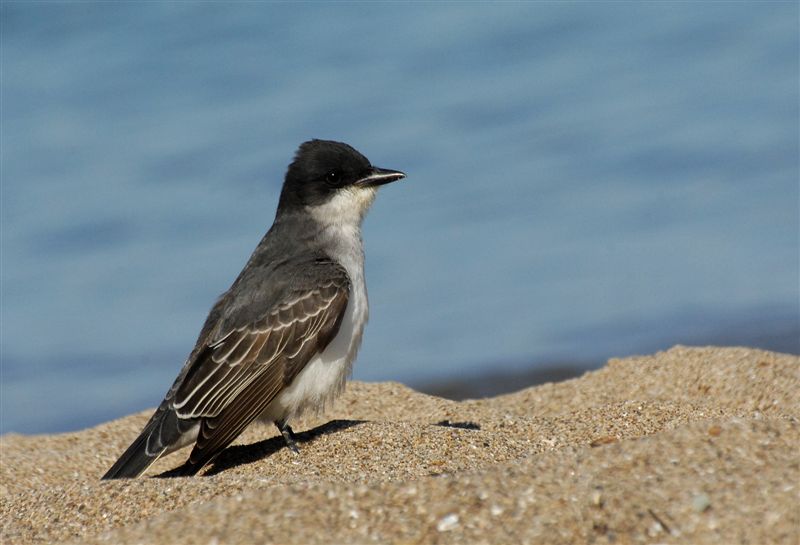
Later in the day the Eastern Kingbirds joined the swallows on the beach


A Pelee post wouldn't be complete without a Scarlet Tanager photo

Eastern Whip-poor-Will that Brandon's dad found one morning

Pelee's second-last going-away present, a singing male Cerulean Warbler - not the first I've seen, or even the first for the trip (I think it was the fourth or fifth), but the first I've ever photographed!

Pelee's last present was a Yellow-throated Warbler, literally as we were driving out of the park. I didn't get any photos but it was my 37th species of warbler for the two weeks (in May) in the park!!! I got my 38th warbler for the year (Connecticut) a few weeks later in Petawawa. Maybe there will be a November mega for me to chase when I'm home to make 39???